Before the Frost: A Selective Cleanup for a Living Garden
Garden Habitat Notes — Use frost dates as a watch signal, not a cleanup deadline: leave healthy stems and leaves where they help, remove disease risks, and protect tender plants before a hard freeze.

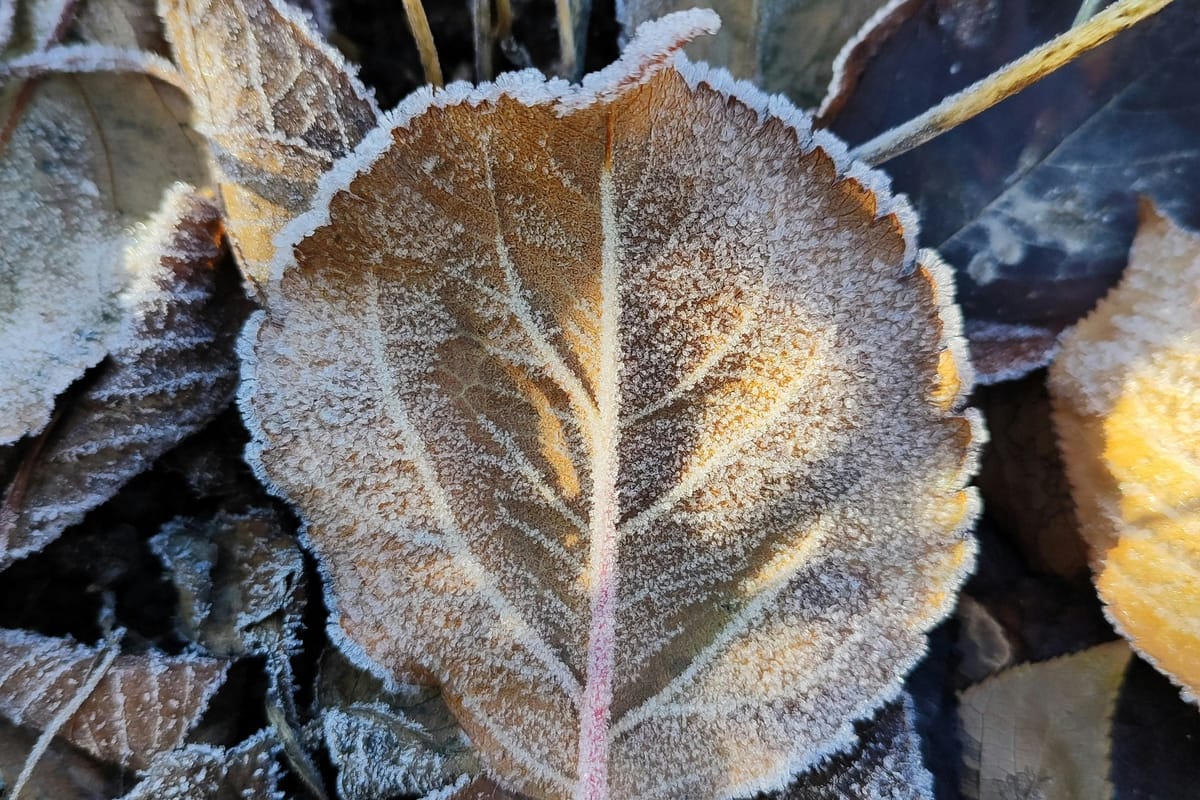
A reader in Ottawa asks: “I have always cut everything back and raked the beds clean before winter. How much cleanup can I skip, and how should I time it around frost?” The useful answer is selective cleanup: protect food and plant health where needed, while leaving some leaves, stems, and seed heads as winter habitat.
What first frost can — and cannot — tell you
Frost timing is regional, not a Canada-wide deadline. The 2026 frost-date compilation lists average first frost dates around September 12 in Saskatoon, September 17 in Regina, September 20 in Winnipeg, September 21 in Calgary, September 23 in Edmonton, September 28 in Quebec City, October 7 in Montreal, October 12 in Ottawa, October 18 in Halifax, November 1 in Toronto, November 30 in Vancouver, and December 15 in Victoria. It says these are historical averages based on Environment and Climate Change Canada climate normals for 1991–2020, not a promise about this year. Individual years can vary by 2–3 weeks; a 50th-percentile date means half of years are earlier and half later. Martha’s Garden Seeds also advises checking the local forecast before moving frost-sensitive plants outdoors. In fall, use the date to begin watching, not to schedule one irreversible cleanup.
The weather station is not your backyard. The frost-date compilation says official temperatures are measured at 1.5 m above ground; on clear, calm nights, the garden surface can run 2–3°C colder, and low spots can collect cold air. From 2–3 weeks before your average date, it recommends treating a clear-night forecast of 4°C or below as a frost watch for tender plants.
First frost also does not end every crop. The frost-date compilation says kale, Brussels sprouts, carrots, parsnips, leeks, cabbage, and spinach can continue for weeks after a light frost, and through winter in coastal BC. It describes a hard freeze of about −4°C or colder as a later endpoint, typically 2–4 weeks after the first light frost, while shortening day length can stop growth regardless of temperature. These crop and timing statements are broad guidance, not a guarantee for every cultivar or site.
Leave room for overwintering life
A perfectly bare bed is not the only definition of good care. The Old Farmer’s Almanac advises leaving leaves under shrubs, in garden beds, and in quiet corners because they shelter overwintering insects and other wildlife. It also recommends leaving healthy perennial stems and seed heads where possible: they can provide winter shelter and bird food.
An Ottawa Citizen garden account describes decomposing leaf litter as overwintering habitat, nutrient return, and mulch. For spring, that account recommends waiting until nighttime temperatures are consistently around 10°C before tidying, while the Almanac cautions that different insects emerge at different times and some use the material well into spring. Treat that as a cautious timing cue rather than a universal biological switch.
The point is not to turn every corner into a wildlife reserve. It is to choose where disturbance is necessary and where it is not.
A selective fall sequence
Work backward from your local frost watch rather than from a fixed national date. Start with the work that protects both habitat and plant health:
- Leave leaves in beds, under shrubs, and in out-of-the-way corners. Remove thick, matted layers from lawns, and keep paths, drains, and ponds clear.
- Leave healthy perennial stems and seed heads standing where they are not obstructing access or creating a known problem.
- Remove diseased foliage and plant material associated with known pest problems. The Almanac gives bearded irises affected by iris borers as an example.
- Treat the vegetable garden separately. The Ottawa Citizen account says fall removal of vegetable debris can reduce overwintering pests and diseases. Do not let a general habitat rule override a crop-health problem.
- Lift and store tender bulbs such as dahlias and gladiolus before a hard freeze if you grow them.
- Move a light layer of lawn leaves into beds instead of bagging them, if the leaves are not diseased and the bed can hold them.
This is not a request to diagnose disease or identify a regulated invasive plant from a newsletter. If either issue is present, use the relevant provincial or municipal disposal guidance. The broader leave-the-leaves principle does not replace local rules.
Adjust the timing to your region
The 2026 frost-date compilation places the average first frost around September 12 in Saskatoon, September 17 in Regina, September 20 in Winnipeg, September 21 in Calgary, and September 23 in Edmonton. In central Canada it lists Quebec City at September 28, Montreal at October 7, Ottawa at October 12, and Toronto at November 1. Halifax is around October 18; Fredericton and Moncton are closer to late September. Vancouver is around November 30 and Victoria around December 15, with the source noting that mild Victoria winters may not see frost until January.
That spread changes what you do first:
- On the Prairies, prioritize harvest, vegetable-bed cleanup, and diseased material because frost watch can arrive while the garden is still busy.
- In central and Atlantic Canada, stage the work: remove problem material first, then leave habitat through the quieter part of fall.
- On the BC coast, do not rush a blanket cleanup. Watch the actual forecast and leave hardy growth where it remains healthy and useful.
In every region, remember that a station average is not a yard-level forecast. A sheltered urban bed, exposed balcony, slope, and low-lying garden can experience different conditions.
Keep this boundary in view
This issue supports selective cleanup and cautious frost timing, but the sources here do not provide species-by-species entomological evidence for which insect uses which stem. They also do not provide provincial invasive-species rules or a complete disease-disposal protocol. Those are evidence gaps, not permission to improvise. Check local government guidance when a plant is regulated, diseased, or part of a known pest problem.
This is not a plant-selection list. Before adding plants, verify local suitability and invasive-species status. For frost-sensitive plants, check your local forecast rather than relying on the average date alone.
Your carry-forward task
This week, walk the garden with a notebook. Record the city or weather station you are using, then mark three categories: leaves and stems to leave, material to remove, and tender plants to watch. Put the average frost date beside the note, and begin checking clear-night lows 2–3 weeks beforehand. In spring, use the same note to resist an automatic cleanup; revisit it when nighttime temperatures are consistently around 10°C, while keeping paths, drains, and any problem material managed.